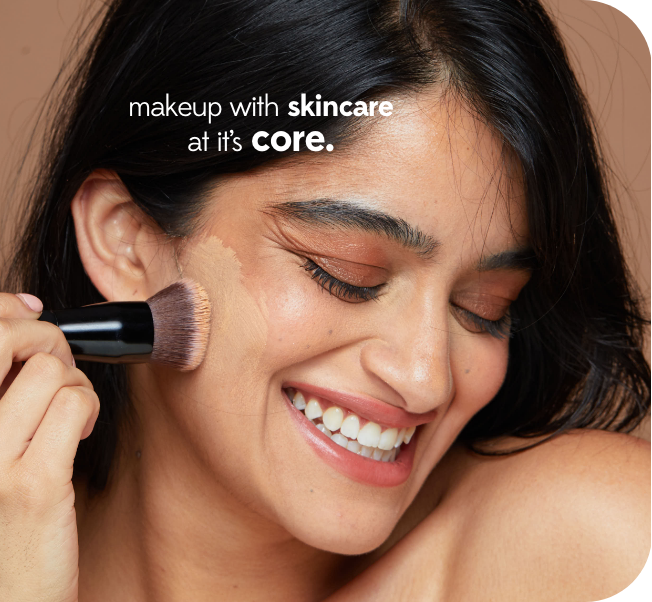
You have probably lived this loop: a breakout appears, you layer on foundation to cover it, and by the next morning, two more spots have joined the party. Concealer becomes armour, primer becomes a daily ritual, and somewhere along the way, you stop asking whether the makeup itself is part of the problem. Spoiler: in most cases, it is. Acne from makeup is not a myth or an exaggeration. Conventional foundations, concealers, and even setting powders are formulated with pore-clogging silicones, synthetic oils, and occlusive polymers that create the exact environment acne-causing bacteria love, warm, sealed, and oxygen-deprived.
The fix is not going bare-faced. The fix is switching to formulas built on ingredients that actively support acne-prone skin instead of suffocating it. And jojoba oil sits at the centre of that conversation.
Why Most Makeup and Acne-Prone Skin Are a Terrible Match
Before we get to the solution, it helps to understand why conventional makeup triggers breakouts so reliably. Makeup causing acne is not random bad luck. The mechanism is specific, predictable, and entirely avoidable once you know what to look for on a label.
The Silicone-and-Seal Problem
Most mainstream foundations and primers lead with dimethicone or cyclopentasiloxane, silicones that create a smooth, "blurred" finish on the skin. That silky feel comes at a cost. Silicones form an occlusive film over the pores that traps sebum, dead skin cells, and bacteria underneath. For oily and combination skin types, especially in India's humid climate, the result is a breeding ground for comedonal acne, the stubborn blackheads and whiteheads that cluster along the jawline, nose, and forehead.
Synthetic Oils and Petrochemicals That Clog Pores
Mineral oil, isopropyl myristate, and petroleum-derived emollients are inexpensive texture agents used across budget and mid-range makeup. On a comedogenicity scale (which rates ingredients from 0 to 5 based on their pore-clogging potential), many of these sit at a 3 or higher. For anyone already prone to breakouts, wearing a foundation rated at that level for 10 hours a day is like leaving a pore-clogging mask on your face, five days a week.
Jojoba Oil: The Ingredient That Tricks Your Skin in the Best Way
Jojoba oil is not actually an oil. Technically, it is a liquid wax ester, and that distinction matters enormously for acne-prone skin. The molecular structure of jojoba oil is remarkably similar to the sebum your skin produces naturally, which is precisely why it works where other oils fail.
How Jojoba Oil Acne Benefits Actually Work
When your skin detects jojoba oil on its surface, it registers the wax esters as its own sebum. The response? Your sebaceous glands dial down production. Less excess sebum means fewer clogged pores, fewer comedones, and a significantly reduced feeding ground for P. acnes bacteria. The jojoba oil acne connection is not about masking the problem. Jojoba oil addresses the overproduction cycle at its root.
On top of sebum regulation, jojoba oil brings a few more things to the table that acne-prone skin desperately needs:
- Anti-inflammatory properties: Jojoba contains myristic acid and natural vitamin E, both of which calm redness and reduce the swelling around active breakouts.
- Non-comedogenic profile: Jojoba oil scores a 2 on the comedogenicity scale, one of the lowest ratings for any oil. For context, coconut oil (a popular "natural" ingredient) scores a 4.
- Antibacterial action: Jojoba oil creates an inhospitable environment for certain strains of bacteria and fungi, making it a natural ally against both acne and fungal skin irritation.
What Non-Comedogenic Makeup Actually Means (and Why Most Labels Lie)
The term "non-comedogenic" appears on half the makeup aisle, yet breakouts persist. That is because no universal standard governs the claim. A brand can slap "non-comedogenic" on a foundation loaded with dimethicone and isopropyl palmitate, and no regulatory body will challenge it.
How to Spot Genuinely Non-Comedogenic Makeup
Genuine non comedogenic makeup earns the label through its ingredient list, not through self-certification. Here is what to look for and what to avoid:
- Safe base ingredients: Jojoba oil, argan oil, squalane, and plant-derived waxes (candelilla, carnauba) score low on comedogenicity scales and support skin barrier function. A skin tint foundation built on jojoba oil and montmorillonite clay works with your skin's natural oil balance rather than sealing everything underneath a synthetic film.
- Natural oil-absorbing agents: Kaolin clay, bamboo silica, rice starch, and arrowroot replace synthetic mattifiers like talc and nylon-12. The Ruby's Organics Compact Setting Powder, for instance, uses rice starch and bamboo silica to control shine without suffocating pores.
- Red flags to avoid: Dimethicone, cyclopentasiloxane, isopropyl myristate, mineral oil (paraffinum liquidum), acetylated lanolin, and anything with a fragrance listing that does not specify the source.
Building a Makeup Routine for Acne-Prone Skin That Actually Heals
Makeup for acne prone skin should not just "not make things worse." At its best, every product in your routine should be pulling double duty, delivering coverage or colour while actively calming, purifying, or protecting the skin underneath.
Start with a Base That Purifies
Your foundation is the product sitting on the largest surface area of your face for the longest stretch. A Ruby's Organics Skin Tint Foundation, formulated with jojoba oil, argan oil, and montmorillonite clay, gives you buildable coverage while the clay draws out impurities and the oils balance sebum. No silicones, no petrochemicals, no synthetic fragrance, just Ecocert-certified ingredients that let your skin breathe and heal while you wear them.
Conceal Without Consequences
Most concealers are the worst offenders for clogged pores because the formula is concentrated and sits in thick layers over the most breakout-prone areas. The Ruby's Organics Hydra Concealer, built on jojoba oil, sweet almond oil, and bakuchiol (a plant-based retinol alternative), provides targeted coverage while actively reducing the appearance of acne scars and fine lines over time. That is the difference between a concealer that hides damage and one that reverses it.
Keep the Standard Across Your Entire Face
Swapping your foundation and concealer to clean formulas loses impact if your setting powder, eye makeup, and lip colour are still loaded with synthetics. A talc-free compact sets your base without comedogenic fillers. A vegetable-carbon kohl with jojoba oil lines your eyes without the petroleum-derived pigments found in conventional kajals. An organic lipstick formulated with plant butters and jojoba keeps your lip routine clean. When every product on your face is non-comedogenic and jojoba oil-based, the cumulative effect on your skin is transformative.
The Bottom Line: Your Skin Deserves a Better Deal
Acne from makeup is not inevitable. When formulas are built on jojoba oil and other genuinely non-comedogenic, plant-based ingredients, your makeup stops being the enemy and starts being part of the solution. The breakout cycle breaks when your products work with your skin's biology instead of against it.
Shop Ruby's Organics for jojoba oil-based, Ecocert-certified makeup designed for skin that breaks out, not down.
Frequently Asked Questions
Q. Can makeup actually cause acne?
Yes. Makeup causing acne, often called "acne cosmetica," is a well-documented condition. Foundations, primers, and concealers containing silicones, synthetic oils, and pore-clogging emollients trap sebum and bacteria beneath an occlusive layer. Over hours of daily wear, this creates the ideal conditions for comedonal acne, cystic flare-ups, and persistent blackheads, particularly along the jawline, nose, and forehead.
Q. Why is jojoba oil good for acne-prone skin?
Jojoba oil is a liquid wax ester whose molecular structure closely mimics human sebum. When applied to the skin, it signals the sebaceous glands to reduce excess oil production, which is a root cause of acne. Jojoba also has anti-inflammatory and mild antibacterial properties, and it scores a 2 on the comedogenicity scale, making it one of the safest oils for breakout-prone skin.
Q. What does "non-comedogenic" actually mean on a makeup label?
Non-comedogenic means a product is formulated not to clog pores. However, the term is not regulated by any governing body in India or most other markets. Brands can use it freely without third-party verification. The most reliable way to confirm a product is genuinely non-comedogenic is to read the full ingredient list and look for third-party certifications like Ecocert or COSMOS.
Q. Should I stop wearing makeup if I have acne?
No. Going bare-faced is not the only solution. The issue is not makeup itself but the specific ingredients in conventional formulas. Switching to non-comedogenic, plant-based makeup formulated with skin-friendly oils like jojoba, argan, and almond allows you to wear full coverage daily without contributing to breakouts.
Q. Which makeup ingredients should acne-prone skin avoid?
Avoid dimethicone, cyclopentasiloxane (silicones), isopropyl myristate, mineral oil, acetylated lanolin, synthetic fragrances, and talc. Look out for "D&C" and "FD&C" dyes as well. Products scoring high on comedogenicity scales or lacking specific ingredient transparency are best replaced with certified clean alternatives.
Q. Can jojoba oil-based makeup help with existing acne scars?
Jojoba oil itself does not erase scars, but it supports the healing environment. Formulas that combine jojoba oil with active ingredients like bakuchiol (a plant-based retinol alternative) and vitamin E can improve skin texture and reduce the appearance of post-inflammatory marks over time. Consistent use of non-irritating, nourishing makeup allows the skin to repair rather than endure further damage.