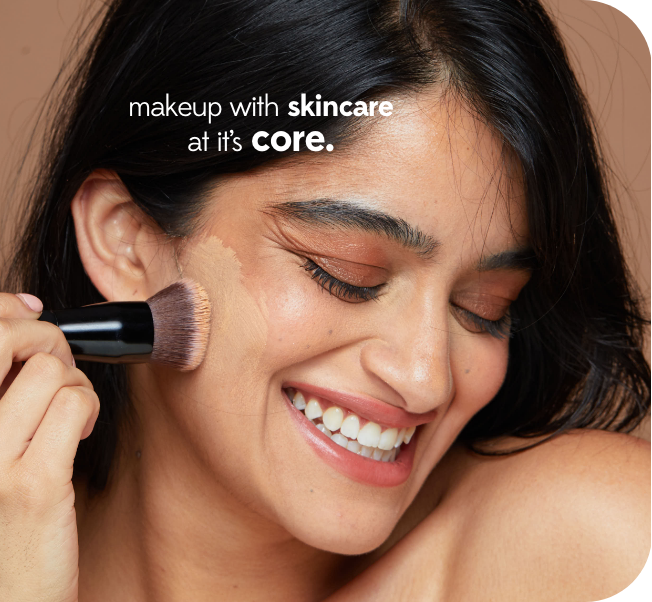
Your setting powder is the last thing you apply and the first thing your skin reacts to all day. If that powder is packed with talc and synthetic binders, you have sealed your routine under a layer your pores never asked for. The shift toward talc-free setting powder is not a label swap. It is a formulation upgrade, especially for Indian skin that deals with humidity, oil, and sensitivity on rotation.
Most women do not think twice about what their compact contains, but those ingredients sit on your face for hours. Here is what talc does, what works better, and how to shade-match a talc-free compact powder for Indian skin.
So What Is Talc, and Why Are Brands Ghosting It?
Talc is a soft mineral (magnesium silicate, if you want the nerdy version) that has been the default filler in pressed powders for decades. It absorbs oil, gives a matte finish, and keeps costs low.
Brands avoid talc for sourcing concerns and skin-feel. Talc is mined, and that process has raised questions about cross-contamination. It also sits on the surface rather than working with your skin. For oily or acne-prone types, that means clogged pores, a chalky cast, and the "powder mask" by 3 PM.
Is talc bad for skin? Not classified as harmful in cosmetic-grade form, but better alternatives exist now.
What Ruby's Organics Uses Instead
The Compact Setting Powder skips talc entirely. The formula is built on rice starch, arrowroot powder, and bamboo silica, three plant-based absorbents that control oil without stripping moisture.
Kaolin Clay for Oil Control
Kaolin clay absorbs sebum at a gentler pace than talc, drawing out excess oil without leaving that tight, dry feeling. For an oily T-zone and normal cheeks (most of us in Indian summers), kaolin is the smarter pick.
Bakuchiol for Skin That Gets Better
Bakuchiol is a plant-based alternative to retinol that reduces the appearance of fine lines and improves skin texture over time. Your compact is no longer just makeup. It is skincare too.
The formula also includes magnesium stearate for smooth texture and coconut amino acid for moisture retention. All ECOCERT/COSMOS certified.
Why Talc-Free Actually Performs Better
This is not performance vs. "clean." It is about a better product.
No Chalky Finish on Deeper Skin Tones
Talc-based powders are notorious for leaving an ashy cast on medium to deep Indian skin tones. Clay-based formulas blend more naturally because they work with your skin's oils instead of sitting on top.
Oily Skin, Meet Your Match
Is talc-free powder better for oily skin? Yes. Kaolin clay absorbs oil gradually, keeping skin matte without that "blotted dry" feeling. Talc absorbs everything at once and stops working, which is why oily types reapply conventional powders multiple times a day. Rice starch and bamboo silica let skin breathe while controlling shine through Indian humidity.
Your Shade Cheat Sheet: SP1 Through SP4
Ruby's Organics offers four shades in the Compact Setting Powder range, each built for Indian skin tones:
| Shade | Best For | Match It With |
|---|---|---|
| SP1 | Light skin tones | Foundation L 01 or LM 01.5 |
| SP2 | Light-medium skin tones | Foundation LM 01.8 |
| SP3 | Medium to medium-deep tones | Foundation M 02 or M 02.2 |
| SP4 | Deep, rich skin tones | Foundation MD 02.5 or D 03 |
Match your compact shade to your Skin-Tint Mattifying Foundation shade. Between two options? Go with the one closer to your neck and chest.
Press, Don't Swipe: How to Apply It
Technique matters with talc-free formulas.
Step 1: Swirl and Tap
- Use the dual-ended brush included with the compact.
- Swirl into the powder and tap off excess.
Step 2: Press Into the T-Zone
- Start with forehead, nose, and chin.
- Press the brush down and roll gently rather than swiping across the surface.
Step 3: Layer Only Where Needed
- Skip powder on normal or dry cheeks.
- Let your foundation or concealer handle the cheeks and keep powder for oil-prone zones.
Step 4: Touch Up Smart
- For midday touch-ups, blot with a tissue first, then lightly press powder onto the T-zone.
- Remove oil first, then set.
The Finish Line (Literally)
A talc-free setting powder respects your skin while doing what a compact should: set, mattify, and blur. When the formula also packs bakuchiol and bamboo silica, your compact stops being just the last step and becomes one of the most important ones.
If your powder cakes or turns chalky by lunch, the fix might not be your technique. It might be your talc. Find your Compact Setting Powder shade and see what a cleaner base routine feels like.
Frequently Asked Questions
Is talc-free powder better for oily skin?
Yes. Kaolin clay absorbs oil gradually, so skin stays matte longer without feeling dried out. A strong fit for normal-to-oily skin in humid weather.
Does talc-free mean it will not look ashy on deeper skin tones?
Clay-based formulas sit more naturally on deeper tones because they blend with your skin's oils. Shade-matching (SP1 through SP4) is still the deciding factor.
Is Ruby's Compact Setting Powder talc-free?
Yes. 100% talc-free, paraben-free, silicone-free, and made with ECOCERT/COSMOS certified ingredients: rice starch, arrowroot, bamboo silica, and kaolin clay.
Can I use talc-free setting powder without foundation?
Absolutely. Press it onto moisturised or primed skin for a soft-matte finish. Works beautifully over just sunscreen and concealer.
Will talc-free powder clog my pores?
No. The formula is breathable and skips silicones, petrochemicals, and synthetic fillers that cause congestion in pressed powders.
How is talc-free compact powder different from loose powder?
A compact is pressed for portability and controlled application. Loose powder gives a lighter finish but is harder to carry and dose. The Ruby's Organics version offers pressed convenience with a breathable, talc-free formula.